

New construction painting starts well before anyone opens a can of finish paint. New drywall needs to be checked, sealed, and coated in the right order. Trim, doors, ceilings, and other new surfaces also need the right prep.
For builders and homeowners in Waco, Temple, and Belton, timing matters just as much. Painting has to fit around drywall crews, flooring, cabinets, HVAC, and electrical work. Paint applied too early gets scuffed and cut into by every trade that follows. Paint applied too late holds up the move-in date.
What Is New Construction Painting?
New construction painting means coating surfaces that have never been painted before.
That usually includes:
- New drywall
- Ceilings
- Doors and frames
- Baseboards
- Interior trim
- Closets
- Other new wood or gypsum surfaces
The process is different from repainting an older home. There are no old paint layers to cover, but there are more new surfaces to inspect and seal.
On a repaint, the old film has already sealed the wall and evened out the suction. In new work, there is no film to help, and every difference in the raw surface has a chance to show.
A typical project includes surface prep, primer, finish paint, and touch-ups. New drywall usually needs primer first. One primer coat is common, followed by one or two finish coats. The exact system depends on the paint, color, sheen, and wall finish.
Why New Drywall Needs Primer
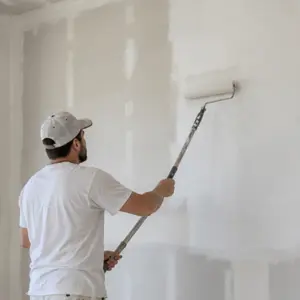
Painting new drywall without primer can leave the wall looking uneven.
Drywall paper and joint compound do not absorb paint the same way. One area may soak in more paint than another. That difference can show through the finish coat.
The Gypsum Association recommends priming new gypsum board before final decoration. Primer helps create a more even surface before color goes on.
Its GA-214 guidance puts it plainly, recommending that the painting specification itself include a priming material applied prior to decoration.
What Is the Best Primer for New Drywall?
The best primer for new drywall is one made and approved for bare gypsum board.
PVA primers are often used on new drywall because they help seal the surface. Other drywall primers may work just as well when approved by the paint maker.
PVA is inexpensive and does the one job it is built for, which is evening out the suction between paper and compound. It does not block stains or hold up well in wet rooms, so bathrooms, laundry rooms, and any surface with bleed-through usually call for something else.
Do not rely only on a label that says “paint and primer in one.” Check the product data first. It should clearly state that the coating can be used on bare drywall.
It also helps to keep primer and topcoat inside the same manufacturer’s recommended system, since mixed systems are the first thing questioned if a warranty claim comes up.
How Many Coats Does New Drywall Need?
A common question is how many coats of primer for new drywall are needed.
For most new drywalls, one complete primer coat is the usual starting point. The number of finish coats can vary.
| Paint Finish | Typical System |
| Finish Level 4 | 1 primer coat + 1 topcoat |
| Finish Level 5 | 1 primer coat + 2 topcoats |
The Drywall Finishing Council uses these systems as part of its paint finish guidance.
That does not mean every project must follow the same coat count. Some builders choose two finish coats for stronger color, better hide, or more durability.
Dark shades may also need more coverage. Deep bases carry less white pigment, so they hide less per coat, and a tinted primer underneath usually saves more time than it costs.
The paint manufacturer’s instructions and the written project scope should guide the final choice.
Level 4 vs. Level 5 Drywall
Not every wall needs a Level 5 finish.
Level 4 works well for many walls that will receive flat paint. Level 5 adds another layer of surface finishing to help create a more even appearance.
In practice, that means a thin skim coat of joint compound, or a product made for the purpose, applied across the whole surface rather than just the joints and fasteners. It carries its own labor and sanding time, which is why it belongs in the drywall contract rather than the paint contract.
| Wall Condition | Good Starting Point |
| Flat paint with soft light | Level 4 may be enough |
| Eggshell or satin finish | Level 5 may be better |
| Dark or deep paint colors | Level 5 is often preferred |
| Large windows or side lighting | Level 5 is often preferred |
The Gypsum Association notes that non-flat paint, dark colors, and strong lighting can make joints easier to see.
That is why drywall finish decisions should happen early. Waiting until after paint is applied can lead to extra sanding, patching, and repainting.
Central Texas Heat, Humidity, and Drying Time
Central Texas weather can affect the construction schedule, even when the painting happens indoors.
National Weather Service data shows that Waco’s normal July high is close to 97°F. The area also sees about 24 days each year at or above 100°F.
The key issue inside the building is control.
Before painting starts, the structure should be weather-tight. HVAC should also keep the indoor temperature and humidity within the paint manufacturer’s recommended range.
Weather-tight is a specific condition, not a general impression. The roof is dried in, exterior doors and windows are installed, and outdoor humidity is no longer moving freely through the house. Where permanent HVAC is not running yet, temporary conditioning does the same job.
Drywall compound needs enough time to dry as well.
USG says joint compound may take about 24 hours to dry at 70°F and 70% relative humidity. Higher humidity or cooler air can slow that process.
Painters should check the wall before moving on. A set number of hours does not always mean the surface is ready.
What Should Be Included in the Painting Scope?
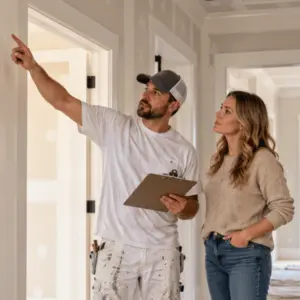
New construction painting prices can vary widely because no two builds have the same scope.
Square footage matters, but it is only one part of the cost. Two houses of the same size can be priced very differently once ceiling height, door count, and trim detail are considered.
A concise quotation should state:
- Which surfaces are going to be painted?
- Level of drywall finish
- The initial product
- Complete the paint job.
- Shine and hues
- The quantity of coats
- Spray, roll, or back-roll techniques
- Included are doors and trim.
- Who takes care of touch-ups?
- How the last inspection will be conducted
Steer clear of ambiguous terms like “premium” or “builder grade.” It is much simpler to compare product names and coat counts.
Touch-ups are also important. Fresh paint can be harmed by electrical work, cabinets, flooring, and trim installation. Who comes back to fix those areas should be stated in the quote.
How long should joint compound dry before painting?
Joint compound needs to be fully dry before primer is applied. USG gives about 24 hours at 70°F and 70% humidity as a common drying time. Cooler or wetter conditions can slow it down. Check the wall itself before painting.
Is it possible to spray new construction paint?
Indeed. Since spraying works well over wide open spaces, it is frequently used on new construction. After spraying, painters may also backroll. The paint and desired finish determine the appropriate technique.
Why do drywall seams occasionally become visible after painting?
Paint can highlight surface differences that already exist. Seams can be highlighted by dark hues, increased sheen, and powerful side lighting. Appropriate primer and improved drywall finishing help lessen the issue.
Can paint and primer in one replace drywall primer?
Sometimes, but not automatically. The product must be approved for bare drywall. Check the manufacturer’s instructions before using it as the first coat.
Is Level 5 drywall worth the extra cost?
It can be when the wall receives dark paint, more sheen, or strong side lighting. Level 5 helps create a more even surface. Flat paint in softer lighting may not need it.
What affects new construction painting prices?
New construction painting prices depend on square footage, wall finish, trim, paint type, coat count, and labor. Detailed trim and higher-sheen finishes may add time. A written scope makes quotes easier to compare.
Good new construction painting comes down to preparation, timing, and clear expectations. The drywall finish, primer, paint system, and indoor conditions all affect the final result. Getting those details right before work starts can prevent costly fixes later.
Building a home or commercial space in Waco, Temple, or Belton? Get a Quote from Choice Painting to discuss the right primer, finish level, and paint system for the project.